
Small Projects, Big Trust: Why Neighborhood-Scale Development Still Matters

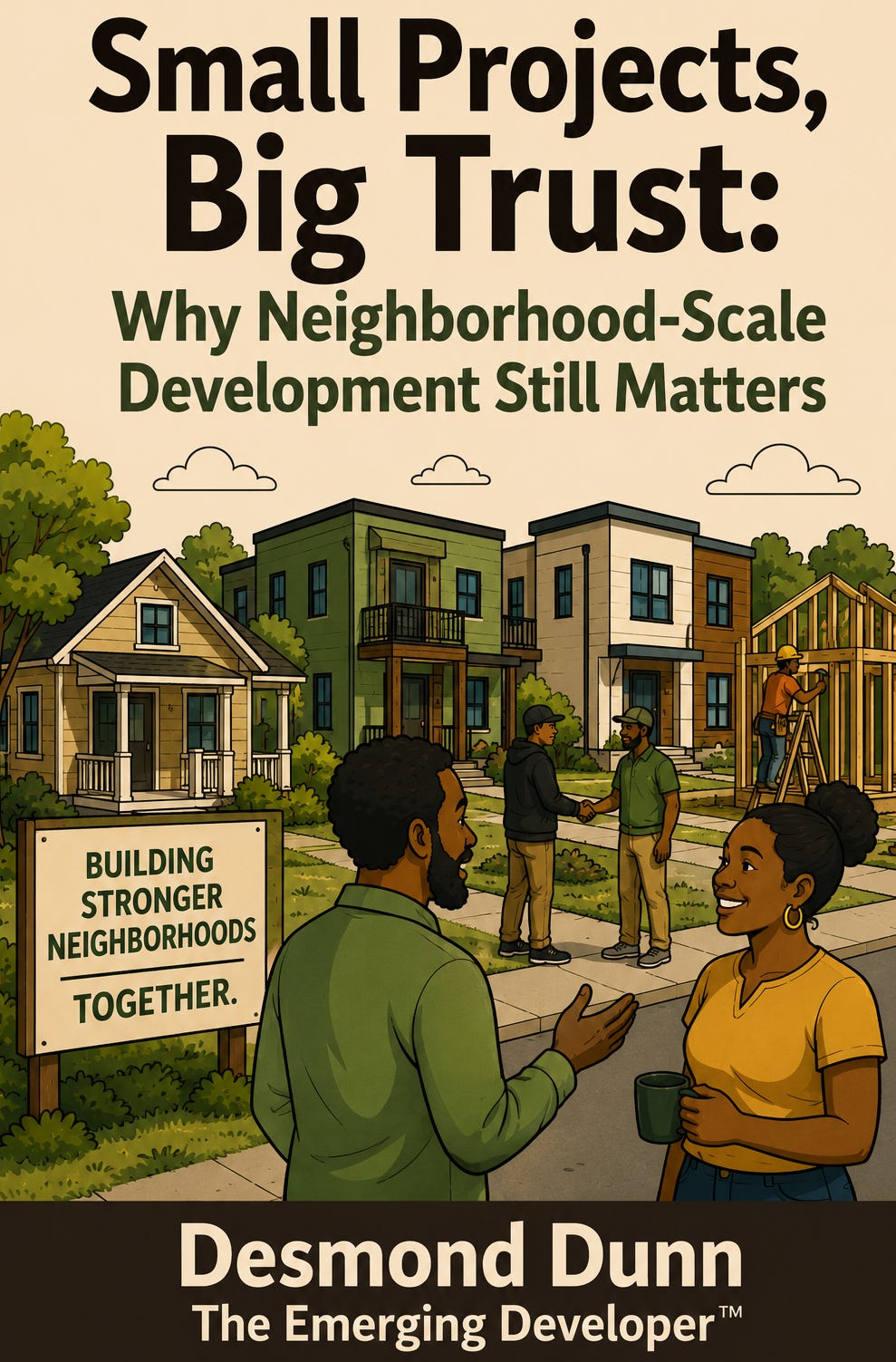
Why neighborhood-scale development still matters
In housing, scale has become the language of legitimacy.
More units. Bigger projects. Faster delivery. Larger capital stacks. Bigger announcements. Bigger renderings. Bigger promises.
And to be clear, we do need housing production. We need more units. We need larger projects in the right places. We need systems that can respond to the depth of the need.
But I think we’re missing something important when we only measure success in unit count.
Because communities experience development emotionally before they experience it statistically.
They feel it in disruption. In uncertainty. In the sense that decisions are happening somewhere else, by people who won’t be around when the dust settles.
They feel it in rising taxes. Higher rents. A landlord suddenly “upgrading” the building. A favorite storefront disappearing. A neighbor moving away. A block that starts to look unfamiliar.
So when residents push back, it’s easy for the industry to reduce it to a simple story: “people don’t like density.”
But a lot of the fear isn’t about new buildings.
It’s about being erased.
People are often more afraid of being erased than they are of new buildings.
That’s why the small stuff matters.
What communities actually experience
Most people don’t live inside planning language.
They live inside daily life.
Can I still afford to stay?
Can my kid still live near me?
Will my church still be here?
Will the corner store that knows my name survive this “revitalization”?
Do I have any say before the plan hardens?
Those are not technical questions.
Those are belonging questions.
And when the answer feels unclear, everything starts to feel like risk.
That’s the part we have to take seriously.
Because a project can technically succeed while emotionally failing the neighborhood around it.
The power of smaller projects
Not every housing solution needs to dominate the skyline to be transformative.
Some of the most impactful projects are smaller, more rooted, and more informed by the people and place around them.
An ADU that helps a homeowner stay.
A duplex or fourplex that fits the block.
A cottage court that makes multigenerational life possible.
A 4–20 unit infill project that adds homes without changing the soul of the street.
A small mixed-use building that brings back a daily need and creates a third place.
Third places are infrastructure.
And what’s different about neighborhood-scale projects is not just the size.
It’s the relationship.
Smaller projects can be more approachable. They can be shaped with neighbors instead of explained to neighbors. They can create visible wins that reduce fear and build confidence.
They can build trust.
And trust is infrastructure too.
Small projects also build local capacity
Here’s another reason this matters.
If only large institutional players can build housing, communities lose long-term ownership capacity.
They lose the chance to produce local developers, local contractors, local architects, local suppliers.
They lose the ladder.
A healthy housing ecosystem should not only produce buildings.
It should also produce builders.
Neighborhood-scale development creates room for emerging developers to participate. It spreads opportunity wider. It creates pathways for local ownership. It helps keep value circulating locally instead of being extracted.
That doesn’t happen automatically.
But small projects make it possible in a way that big projects often don’t.
Development is cultural, not just financial
Housing is not only a unit.
It’s a neighborhood.
Front porches. Corner stores. Walkability. Familiar faces. The places where you bump into people without planning it.
You can finance a building and still fail the block.
You can deliver units and still lose belonging.
That’s why mixed-use corners matter. That’s why neighborhood retail matters. That’s why the fabric matters.
Not just what we build, but how we build.
We need both scale and trust
This is not “small good, big bad.”
We need large-scale housing. We need transit-oriented development. We need institutional capital. We need regional strategies that take scarcity seriously.
And we need neighborhood-scale development, local ownership pathways, and small-developer ecosystems that make change feel less like replacement and more like renewal.
The future of housing is not large versus small.
It’s whether different scales of development can work together.
Policy creates permission. Delivery creates belief.
Policy matters. Zoning matters. Financing matters.
But communities believe what they can see.
Smaller projects create proof. They demonstrate possibility. They build confidence. They create momentum.
Communities rarely trust a vision statement before they trust visible results.
That’s why neighborhood-scale development still matters.
Because sometimes the most important projects aren’t the ones that solve the whole housing crisis in one shot.
They’re the ones that help a neighborhood believe in development again.
Call to action
If you’re in city government: are you creating real pathways for neighborhood-scale builders, or only making room for the biggest players?
If you’re a lender or funder: do you offer right-sized money for right-sized projects, or are small developers forced to “grow up” before they can even start?
If you’re a university or anchor institution: are you investing in local capacity, or only in outcomes you can ribbon cut?
And if you’re a developer: are you building to win the deal, or building to earn trust?
Because the future of housing can’t only be measured in unit count.
It has to be measured in trust, participation, dignity, and local economic integration.
Not every housing solution needs to be big to be transformative.
Sometimes the most transformative projects are the ones that fit the neighborhood and help hold it together.