
Good Intentions Don’t Stop Displacement

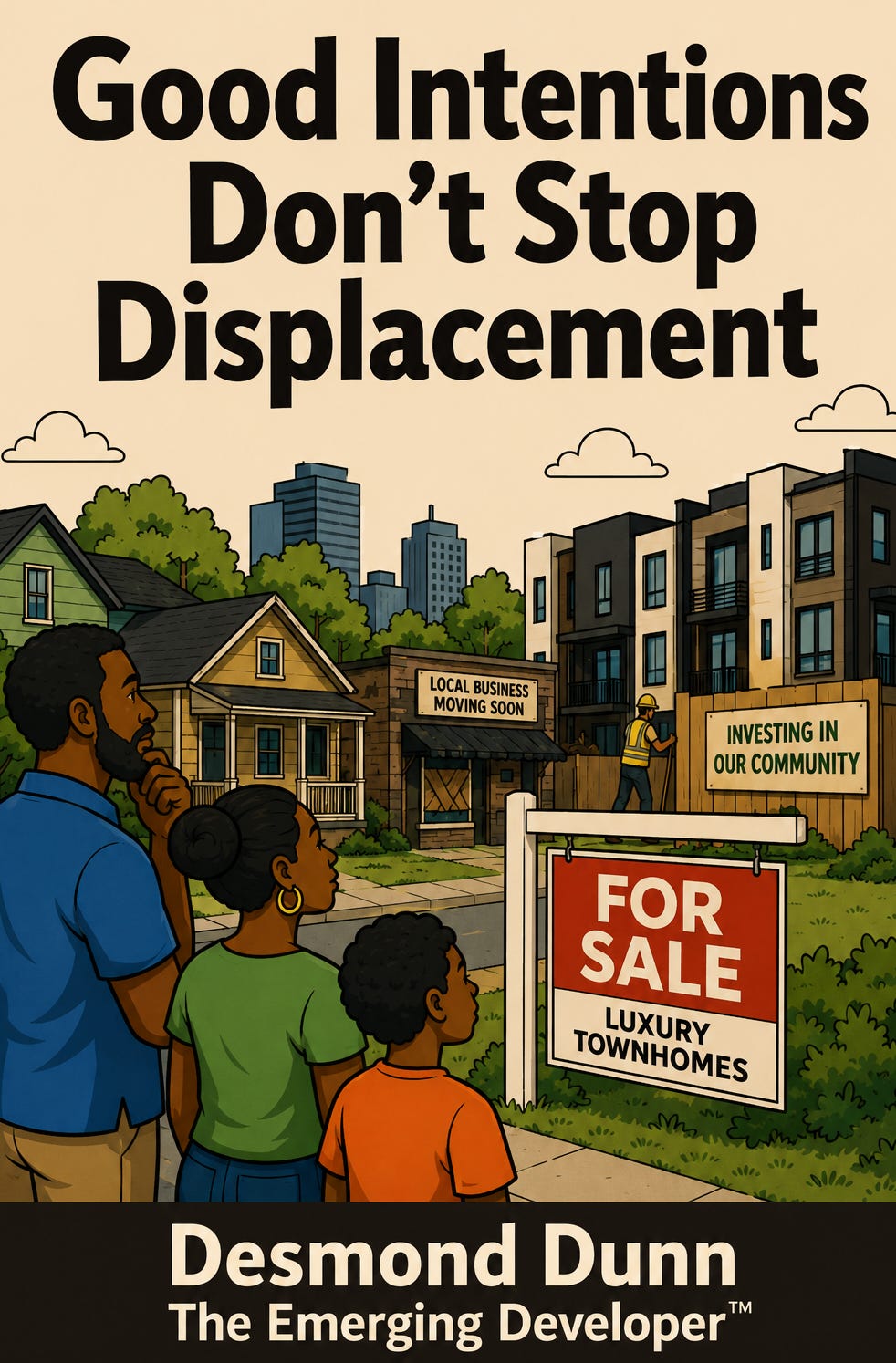
I’ve been in enough rooms to recognize the pattern early.
The kickoff is hopeful. The language is right. The intent is clean.
“We want affordability.”
“We want revitalization.”
“We want to support local businesses.”
“We want the neighborhood to benefit.”
And I believe people when they say it.
But I’ve also been involved in multiple projects where the intention was good from the very beginning, and the harm was still baked in. Not because anyone wanted displacement.
Because good intentions don’t stop displacement.
Displacement happens when the plan increases pressure faster than it increases protection.
That’s the part we have to say out loud, especially when we’re working across multiple communities.
Why this matters in every community, not just “hot” ones
A lot of people talk about displacement like it only happens in the same handful of “booming” cities.
That’s not true.
Displacement shows up anywhere a plan creates new value without building new guardrails.
And it can show up in different forms:
A homeowner gets priced out through taxes, insurance, or deferred repairs they can’t afford anymore
A renter gets pushed out when the landlord sees a chance to raise rents or “renovate”
A legacy business loses its lease when the corridor gets attention and rents reset
A nonprofit loses space because the building is “repositioned”
A neighborhood loses its social fabric long before it loses its people
That’s why I’m convinced of this:
If we’re creating housing and economic plans across four different communities, every one of them has to include proactive anti-displacement.
Not as a chapter at the end.
As a spine that runs through the entire plan.
The uncomfortable truth: revitalization is a pressure machine
This is the part that makes people uncomfortable, especially professionals who care about doing the right thing.
But we have to be honest about what planning does.
Planning is not neutral.
A plan can change expectations.
Expectations change speculation.
Speculation changes prices.
Prices change who can stay.
So even the best plan can become a signal to the market: “This area is next.”
And if protections aren’t already in place, the plan becomes a roadmap for extraction.
Not just what we build, but how we build.
How we spot displacement before it happens
When we “flush through” a plan the right way, you can see the pressure points coming. Almost like a stress test.
Here are some of the signals I look for:
1) The plan increases land value without stabilizing existing residents
New streetscape, new branding, new rezoning, new incentives. But no repair dollars for existing homeowners. No tenant protections. No acquisition tools. That’s a gap.
2) The affordability strategy is only about new units
New affordable housing matters. But displacement often starts in existing housing. If the plan doesn’t protect current renters and homeowners, it’s incomplete.
3) The commercial strategy doesn’t match local reality
A corridor plan that “supports retail” but doesn’t address commercial rent, tenant improvements, or local leasing strategy is basically inviting replacement. Small businesses don’t get displaced by ideas. They get displaced by rent resets.
4) The timeline assumes protection can come later
This is the most common mistake. The plan treats anti-displacement like phase two. But the market responds in phase one.
What proactive anti-displacement actually looks like
Proactive doesn’t mean perfect. It means sequenced.
It means the plan includes protections that move at the same speed as the investment.
A real anti-displacement approach usually includes some mix of:
Home repair + weatherization funds so longtime owners aren’t forced out by deferred maintenance
Property tax relief for legacy residents, especially seniors
Tenant stability tools like eviction prevention, right-to-counsel, and clear relocation policies when redevelopment happens
Right-to-return when public action triggers displacement
Acquisition funds so mission buyers can compete before speculation takes over
Community ownership tools like land trusts and shared equity
Commercial affordability (affordable rents, TI support, and leasing strategy for neighborhood-serving tenants)
Clear metrics that track displacement risk, not just units produced
Policy creates permission. Delivery creates belief.
Anti-displacement is delivery.
It’s how we make sure the people who held the community together get to share in the benefits of change.
The reframe
We have to stop treating displacement like an unfortunate side effect.
It’s a predictable outcome when protection lags behind investment.
So the standard for any housing or economic plan should be simple:
If this plan succeeds, can the people who live here now afford to stay and benefit?
If the answer is unclear, the plan isn’t finished.
Call to action
If you’re leading planning work in your city, ask this early:
What is our anti-displacement move in the first 90 days, not the last chapter?
If you’re a developer, lender, or institution, ask:
Are we adding value to the community, or just raising pressure?
And if you’re a neighbor, ask the question that cuts through the noise:
Who is this plan for, and what protections make that real?
Because good intentions don’t stop displacement.
Only proactive protection does.
Very well written and exceptional content. I consider myself a new urbanist - that's what my college thesis was all about 40 years ago, when these concepts first emerged.
My belief is that politics often derails good ideas and creates more friction than lubrication. These distractions can also enable a loss of focus, with "political will" creating systems that become top-down versus bottom-up. The affordability crisis is the big rock we should be focused on, yet we get distracted by smaller stones. The "shortage" narrative gives permission to chase quantity over quality, when quality should actually mean walkable, livable places with mixed-use destinations—places people "want-to-be" because there's something to do there, not meander "vertical neighborhoods" where you walk around aimlessly.
I live in the nation's gentrification hub: Nashville, Tennessee. Many call me an opponent of development, but I'm not; I make my living in that space. I'm simply in favor of development that avoids becoming a stimulant or incentive before policies and protections are in place. Additionally, we must consider how preprotection policy development works against families who are vulnerable or desire to own a home versus becoming permanent renters.
These are the conversations that should be happening with communities in our cities.
An additional concern - and without doubt this is happening in Nashville - is that the zest for quantity is occurring based on a belief that quantity fixes everything. It's okay for communities to take a deep breath and examine how these mechanics work. I absolutely agree that protective policies must be in place, or harm is launched even before development occurs due to speculation.
For architecture and design, walkability, and livability, it's also necessary to work with communities, rather than on them, and not to hand the keys over to developers and just see what happens. It is absolutely true that making a place that you may want to walk to or even drive to is the ultimate success.
The downside is that it takes time. The upside is creating great places and doing it right the first time; in the end, it saves you time, and do-overs are rare.
I'm thankful to discover a writer who can also simplify this, as that is a challenge for me. Thank you.