
Belief Was 2025. Execution Is 2026.

On a good day, ideas feel like progress.
On a hard day, they are just paper.
We have all sat in the room where the plan is polished, the renderings are beautiful, the language is confident. Everyone nods. Everyone takes a photo of the slide.
And then six months later, the block looks the same.
Same vacant lot.
Same broken sidewalk.
Same neighbors asking, “So what happened?”
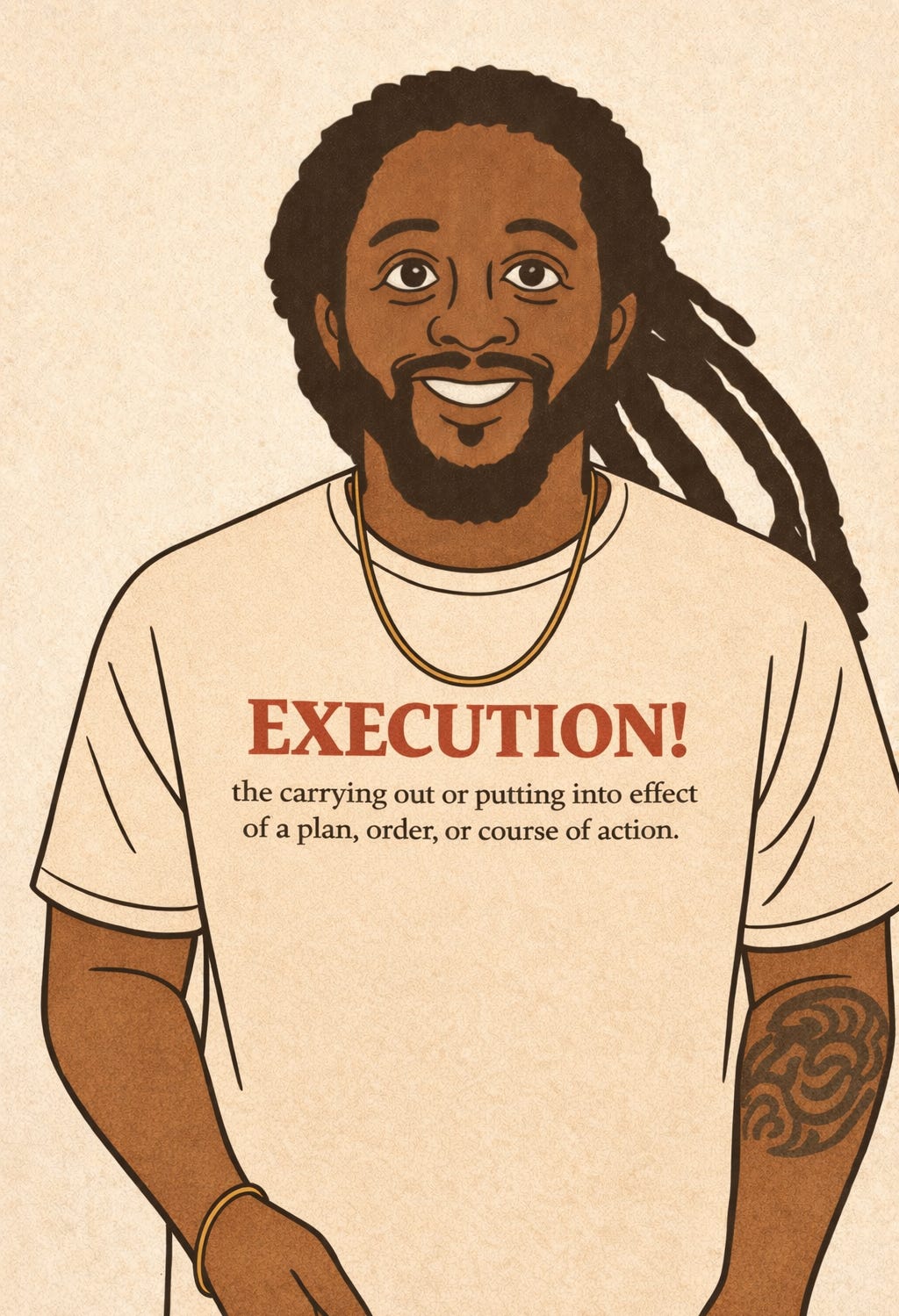
That gap is why my word for 2026 is EXECUTION.
Context
As the New Year arrives, many of us are stepping into plans that took months to create.
I want to pause for reflection.
And then I want to get moving.
Because of my superpower (ADHD), I have never been great at New Year’s resolutions. The “do 12 perfect habits for 12 months” format has never fit my brain or my life.
But I have found something that works.
A theme. A word. A direction.
Last year, my word was BELIEF.
I was taking a risk. Pivoting. Putting myself out there. Setting the foundation. Establishing who I am and what I stand for.
And I knew that whatever I accomplished in 2025 would only happen if I had full belief in what I was doing.
BELIEF got me into rooms.
BELIEF got me conversations.
BELIEF helped me name the work I want to do in the built environment.
Now the foundation is set.
This year needs to be different.
This year is about the next step.
Framing question
If belief is the spark…
What turns that spark into keys in hands and lights on at dusk?
Insight: what I’ve learned about where plans go to die
In my experience as an Emerging Developer, I have seen good ideas lose steam right when they reach the phase that actually matters.
The execution phase.
The part where the work must get done.
The part where budgets become real.
The part where schedules, permits, financing, and neighborhood trust all collide.
I have also seen this as a consultant.
Organizations spend real money on what we call shelf documents.
They look good.
They sound good.
They even make you feel good.
But they sit.
Because there is no delivery muscle behind them.
No staffing plan.
No capital stack strategy.
No pipeline of projects.
No owner for the next step.
No timeline that matches real procurement and real permitting.
No “who does what by when.”
So the plan becomes a performance.
And the community is left holding the disappointment.
That is why I keep coming back to this:
Policy creates permission. Delivery creates belief.
A policy can allow a duplex.
Execution gets it built.
A plan can say “we need affordable housing.”
Execution is how families actually move in.
Not just what we build, but how we build.
What EXECUTION actually means
EXECUTION is not hustle culture.
EXECUTION is not rushing.
EXECUTION is not ignoring neighbors in the name of speed.
EXECUTION is putting real ideas to work.
It is the discipline of turning strategy into routines, resources, and relationships that can carry a project across the finish line.
EXECUTION is how change shows up in the world.
Block by block, with neighbors as partners.
Receipts: the people who didn’t just talk
When I think about execution, I think about leaders who didn’t stop at analysis or speeches.
They built practices.
They created programs.
They made institutions move.
Fred Hampton didn’t just talk about dignity. He helped organize real services that met real needs: food, health care support, political education, and protection. Whatever you think of the politics, the lesson is clear.
He executed.
Jane Jacobs didn’t just critique planning from a distance. She organized neighbors. She fought destructive projects. She helped shift the way cities think about streets, safety, and community life.
She executed.
Malcolm X didn’t just speak. He organized. He built institutions. He created pathways for people to learn, mobilize, and act.
He executed.
Different contexts. Different ideologies. Different outcomes.
Same shared trait.
They didn’t just imagine a better world.
They built the steps.
Two lanes. One standard.
Execution is my word for 2026 because it forces clarity.
Not just in what I believe.
But in what I deliver.
And my work this year lives in two distinct lanes that reinforce each other.
Lane 1: The Emerging Developer
The Emerging Developer is a platform dedicated to the education and empowerment of smaller, community-minded developers.
This lane is about people.
The folks trying to do a duplex, a fourplex, a small rehab, a mixed-use corner, an ADU, a cottage court.
Small, smart, within reach.
But too often, the system is not built for them. The forms are confusing. The financing is mismatched. The process is opaque. The “how” is kept behind closed doors.
So The Emerging Developer is about building capacity.
Belief through practice.
Execution through education.
In 2026, that looks like:
Teaching the real sequence: site control, zoning, design, financing, permitting, construction, lease-up
Sharing plain-language tools: checklists, underwriting basics, lender readiness, and the first-draft pro forma
Helping developers shape right-sized projects so they can find right-sized money for right-sized projects
Naming the trust work so neighbors stay partners, not audiences
Building a pipeline mindset so one project turns into a practice, not a one-off miracle
This is how we grow more community-minded builders.
Not just what we build, but how we build.
Lane 2: r.plan
r.plan is a planning and consulting firm built for execution.
On the r.plan side, we partner with leaders who are trying to solve complex planning and management challenges, with a focus on turning ideas into outcomes. r.planning group+1
r.plan’s work is grounded in three things: community-informed engagement, rigorous analysis, and hands-on implementation. r.planning group+1
That’s not branding.
That’s the difference between a plan that sits and a plan that moves.
Our services show up across three buckets:
Urban Planning and Economic Development: strategic planning, impact measurement, neighborhood and corridor planning, inclusive growth, and engagement design r.planning group
Redevelopment Advisory Services: market context, development strategy, financing alignment, and project management that coordinates timelines and deliverables r.planning group+1
Data Analytics, GIS Mapping, and Dashboards: analysis, mapping, custom dashboards, and visual storytelling so decision-makers can act with clarity r.planning group+1
And our values are plain:
People first.
Get stuff done.
Trust and integrity.
That is execution culture.
Because r.plan exists for the clients who are tired of shelf documents.
-Municipalities.
-Nonprofits.
-Developers.
-Colleges and universities.
Teams that need a plan that includes ownership, sequencing, and accountability so the work is being executed.
Reframe
A lot of people treat policy like the finish line.
I don’t.
Policy creates permission. Delivery creates belief.
A plan without execution is not a plan.
It’s a promise with no legs.
And in housing, broken promises don’t just hurt feelings.
They cost years.
They cost trust.
They cost people their chance to remain and return.
So in 2026, I’m choosing execution as my standard.
Not just what we build, but how we build.
Not just what we announce, but what we deliver.
Monday practice
If you’re stepping into 2026 with a plan, here’s a simple execution move:
Write down the next three actions that get your plan out of the document and into the world.
Assign one owner to each action.
Put a date on the calendar.
If you can’t name the next three actions, the plan is not ready.
It’s still an idea.
Call to action
Your turn.
Where have you seen a great plan lose momentum when it hit execution?
And what is one practical step your organization could take in the next 90 days to close that gap?